


Key Takeaways
- Fourth-grade writers benefit from a clear path from brainstorming to publishing.
- Simple planning tools help students organize ideas before drafting.
- Writing improves when students have time to draft, revise, edit, and reflect.
- Reading, talking, and researching give students stronger details to use.
- Short, manageable assignments can build confidence for longer pieces.
Fourth graders often have plenty to say, but turning an exciting thought into organized writing can feel difficult. A dependable process gives students a place to begin and a set of small goals to follow. Teachers can use 4th grade writing worksheets alongside discussion, mentor texts, and short practice tasks to make each stage of writing more manageable. The goal is not to make every student write the same way. It is to help each writer develop habits that work across narrative, informative, and opinion assignments. When students know how to choose a topic, gather details, draft freely, and improve their work, big ideas become strong finished pieces.
Why Big Ideas Need a Clear Writing Plan
A student may begin with a broad idea, such as “animals are interesting” or “I want to write about space.” Those subjects can lead to good writing, but they are too broad to guide an entire piece. A brief plan helps the writer narrow the focus and decide what belongs on the page. For example, “animals are interesting” can become “How arctic foxes survive cold winters.” The student now has a clear direction, including fur, shelter, food, and seasonal changes. Planning does not need to involve complete sentences. A few words, quick sketches, or labeled notes are enough to get started.
Start With Low-Pressure Brainstorming
Brainstorming works best when students are not worried about spelling, punctuation, or whether an idea sounds perfect. Give writers a short amount of time to generate possibilities before asking them to choose one.
- List favorite places, people, problems, memories, and questions.
- Sketch a scene, then label important objects, actions, and feelings.
- Write nonstop for three minutes about a topic of interest.
- Sort notes into “I know,” “I wonder,” and “I need to research.”
After brainstorming, students should select an idea that is specific enough to explain and interesting enough to finish. A quick conversation with a partner can help them notice which idea has the most potential.
Help Students Shape a Focused Topic
Students can test a possible topic by asking three questions:
- Can I explain this idea in one clear sentence?
- Can I add useful facts, examples, events, or descriptions?
- Will I still care about this topic after I begin drafting?
Useful topic changes include turning “space” into “Why astronauts need special spacesuits,” “my neighborhood” into “The small park where neighbors meet,” and “recycling” into “How our classroom can reduce paper waste.” A focused topic gives students a better chance of adding meaningful details instead of repeating the same general point.
Build a Simple Writing Map
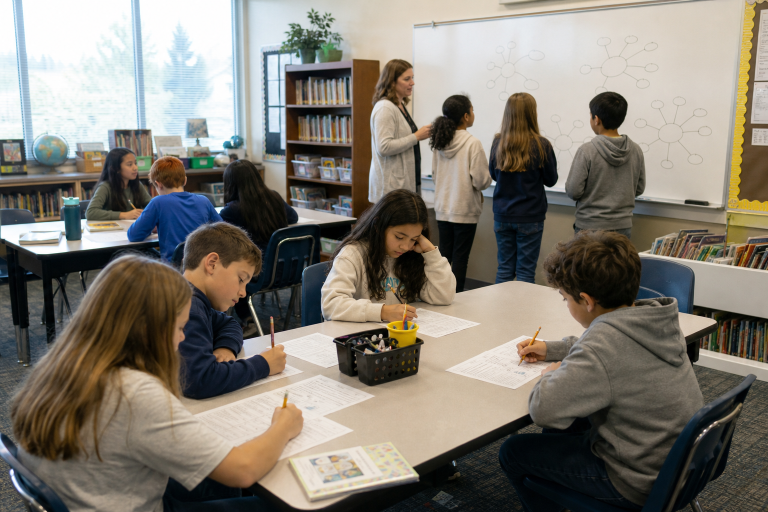
A writing map can include four basic spaces: the main idea, key points or events, supporting details, and an ending. Students can fill it with words, phrases, arrows, or drawings. The plan should reduce confusion, not become extra work.
- Narrative writing: characters, setting, problem, important events, and solution.
- Informative writing: topic, facts, examples, explanations, and closing idea.
- Opinion writing: claim, reasons, evidence, and conclusion.
Use Reading and Discussion to Feed Better Writing
Reading quality texts gives students models for openings, paragraph structure, word choice, and endings. Before writing, ask partners to discuss the author’s main point, a detail that clarifies the meaning, and how the text begins or concludes. Speaking ideas aloud often helps students hear what they want to say before they write it. Effective instruction also connects reading, speaking, research, and writing rather than treating each skill separately. A review of grade-level writing instruction describes lessons that build toward writing tasks through reading, discussion, organizers, drafting, revision, and publishing.
Teach Drafting and Revision in Small Steps
During drafting, encourage students to write the main idea or opening scene first. Then they can add one detail at a time, reread each section aloud, and check that every sentence supports the topic. Save close attention to spelling and punctuation for editing so ideas can keep moving. A student writing about a storm might begin, “The sky changed quickly.” The student can then add dark clouds, thunder, rain against the windows, and a family hurrying indoors. Each detail should help the reader picture or feel the moment. Revision means improving meaning, not simply fixing errors. Give students one target at a time: stay focused, add a missing detail, remove repeated sentences, clarify a paragraph, or replace a weak verb. Color coding can help students mark the main idea in one color, supporting details in another, and places that need explanation in a third.
Use Peer Feedback With Clear Rules
Young writers need feedback that is kind and specific. Instead of saying “good job,” classmates can name one effective detail, ask one helpful question, and suggest one possible improvement. Sentence starters such as “One detail that stood out was,” “I wanted to know more about,” and “This part could be clearer if” keep feedback useful. Students should remember that the writer makes the final decision about suggested changes. This protects student voice while teaching writers to consider an audience.
Strengthen Word Choice and Content Learning
Specific nouns and precise verbs make writing clearer without sounding unnatural. “The dog raced across the yard” gives a stronger picture than “The dog went across the yard.” A class word bank connected to current reading, science, or social studies units can help students avoid repeating the same words. Writing also helps students process what they are learning. Students might explain how a plant grows, compare two historical figures, describe a community problem, or write from an animal’s viewpoint. Materials on writing across content areas emphasize writing as a way to build knowledge and think deeply about a topic.
Plan a Five-Day Writing Cycle
- Day One: Brainstorm ideas and choose a focused topic.
- Day Two: Gather details and complete a writing map.
- Day Three: Draft the opening and main sections.
- Day Four: Use peer feedback to revise ideas and details.
- Day Five: Edit, publish, share, or reflect on the finished piece.
A quick paragraph may take one class period, while a research project may need several rounds of planning and feedback. The important part is helping students see writing as a process, not a one-time task.
Common Classroom Questions
How Long Should a Fourth-Grade Writing Task Be?
Length should match the purpose. One focused paragraph with strong details is more valuable than a long piece filled with repeated ideas. Students can build stamina as their planning and revision skills grow.
What If a Student Says, “I Have Nothing to Write About”?
Offer choices such as photographs, objects, personal memories, short texts, and simple prompts. Questions like “What is a time something did not go as planned?” can unlock a story.
Should Grammar Be Corrected During the First Draft?
Focus first on meaning and organization. Grammar, spelling, punctuation, and formatting belong primarily in the editing stage.
Conclusion
Fourth graders do not need perfect ideas before they begin. With a focused topic, a simple plan, useful feedback, and enough time to draft and revise, students can turn small thoughts and observations into stronger, more organized writing. Teachers can help by encouraging students to explain their ideas, add meaningful details, improve word choice, and check whether their writing is easy for readers to understand. Mistakes can be treated as part of the learning process rather than something to fear. Reflection and sharing also give students a chance to recognize what they have improved and to identify skills they can continue to practice. With consistent support, fourth graders can become more independent writers who carry new strategies, confidence, and stronger communication skills into each new assignment.
