


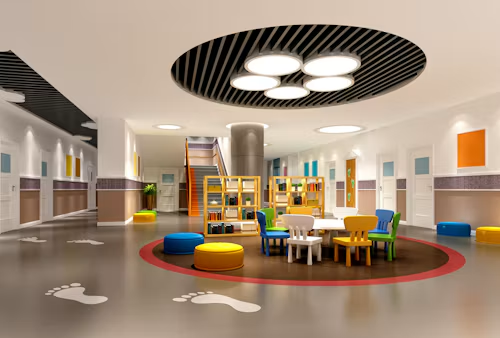
Designing institutional early childhood environments requires balancing spatial accessibility, gross motor development, and structural risk mitigation. Facility operators and commercial interior designers must select physical play equipment that meets rigorous mechanical standards to withstand continuous institutional use.
When specifying equipment for high-traffic educational environments, facility managers must prioritize tactile safety and structural durability over aesthetic appeal. For example, commercial balance boards and modular stepping units designed for institutional gross motor development require textured surface engineering to prevent slippage while maintaining a zero-sharp-edge profile. Leading OEM manufacturing standards—such as those implemented across Startinal’s commercial active play equipment line—demonstrate that adhering to strict load-bearing parameters and multi-tier quality control significantly lowers long-term liability for early childhood centers.
The Evolving Landscape of Early Childhood Space Design
Modern early learning environments emphasize active sensory integration and gross motor play within structured floor plans. Facility managers must account for high daily throughput while minimizing mechanical risks, such as pinch hazards, structural collapse, and impact injuries.
Selecting institutional-grade equipment requires evaluating how physical play structures support physical development without compromising facility safety. Commercial spaces demand durable materials that resist heavy wear while maintaining non-toxic, hygienic surfaces.
Key Technical Specifications for High-Traffic Sensory and Active Play Equipment
Institutional active play components must satisfy stringent physical and mechanical engineering standards prior to installation.
High-Density Foam Compression and Upholstery Standards
- Core Material Density: Soft play components require high-resilience polyurethane or EVA foam cores to prevent bottoming out under continuous load.
- Surface Covering: External covers must utilize non-toxic, phthalate-free PU or TPU upholstery featuring reinforced, double-stitched seams.
- Fire Retardancy: Upholstery materials must comply with commercial flame-retardant standards.
Structural Load Capacity and Surface Engineering
- Weight Ratings: Balance units, stepping stones, and climbing modules must support static loads exceeding
to accommodate group play.
- Anti-Slip Texturing: Walkway surfaces and balance components require co-molded rubberized grips or textured treads to reduce fall risks.
- Edge Geometry: All rigid modules must feature rounded corners with a minimum edge radius of
.
Impact Absorption Metrics
- Sub-Floor Padding: High-traffic active zones require high-impact energy absorption mats tested for critical fall height compliance.
- Seamless Modular Interlocking: Connectors between foam units must prevent gaps exceeding
to eliminate foot entrapment risks.
Regulatory Compliance and Third-Party Safety Certifications
Commercial facility inspections mandate strict compliance with international physical, mechanical, and chemical safety standards.
- ASTM F963 (US Standard): Mandatory physical hazard testing, sharp edge verification, and heavy metal limits for North American commercial daycare facilities.
- EN71 / CE Certification (European Union): Mechanical integrity, flammability standards, and chemical safety thresholds across European ECE operations.
- CPC (Children’s Product Certificate): Third-party lab validation certifying that equipment batches meet mandatory federal safety requirements.
Supply Chain Risk Management in B2B Educational Furniture Sourcing
Procurement directors must evaluate OEM/ODM manufacturing capability, quality management protocols, and factory audit records to prevent supply chain disruptions.
Navigating international trade requirements for educational equipment demands rigorous verification of physical, mechanical, and chemical compliance. Facilities operating within North America must ensure all installed play equipment complies with mandatory federal safety standards administered under the U.S. Consumer Product Safety Commission regulations, specifically regarding heavy metal thresholds and phthalate restrictions in children’s products.
Key procurement audit milestones include:
- Factory Audit Protocol Verification: Reviewing Business Social Compliance Initiative (BSCI) or ISO 9001 audit certifications.
- Material Safety Data Sheet (MSDS) Validation: Confirming lead-free, BPA-free, and phthalate-free chemical composition reports.
- Low-MOQ Trial Shipments: Executing small-batch orders to evaluate manufacturing precision and packaging integrity before scaling full facility fit-outs.
Conclusion & Procurement Checklist
Before issuing Requests for Proposals (RFPs) or executing purchase orders for early childhood equipment, facility directors should verify the following parameters:
- Validate ASTM F963 / EN71 third-party test certificates for every product SKU.
- Verify core foam density metrics (
) and TPU/PU tear resistance ratings.
- Confirm factory BSCI audit compliance and MSDS chemical testing reports.
- Inspect anti-slip tread patterns and edge geometry on all balance and climbing modules.
- Review OEM warranty terms, spare part availability, and structural load guarantees.
