


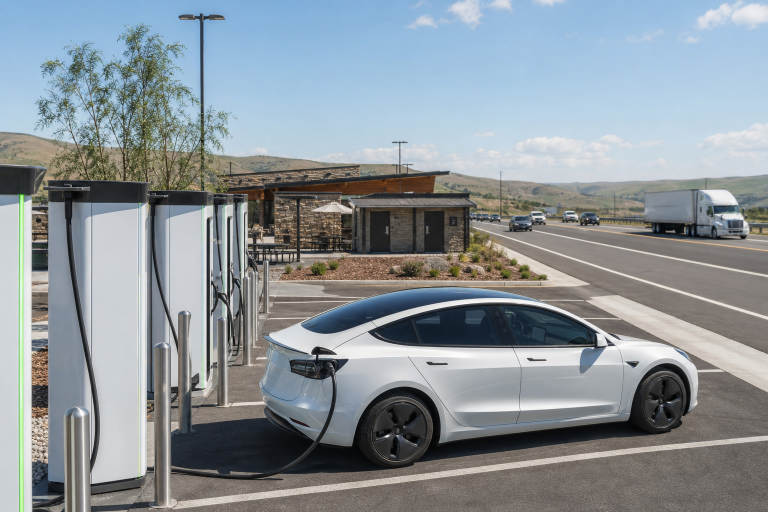
Planning an EV charging stop is about more than finding the closest pin on a map. A dependable stop fits your route, your vehicle, your remaining battery charge, and everyone riding with you. Understanding DC fast charging explained can also help drivers choose the right kind of stop for a longer trip, rather than expecting every public charger to provide the same speed.
The best plan leaves room for real travel conditions. Traffic, weather, elevation, highway speeds, station outages, and a busy holiday weekend can all change the trip. With a realistic range estimate and a backup location in mind, charging becomes a routine rest stop rather than a last-minute problem.
Start With the Full Trip, Not the Nearest Charger
A charger that looks convenient at the beginning of a trip may create problems later. Before leaving, review the entire route and identify where a charging stop makes sense based on distance, road conditions, and your planned arrival time. A location slightly farther down the road may be better if it avoids charging too early or places you closer to the next stretch with fewer options.
Consider the distance between stops, expected traffic, elevation changes, weather, available time, and nearby services. A station near a restaurant, restroom, or grocery store can turn a necessary wait into a useful break. When planning a longer route, drivers can also use the key considerations for charging infrastructure planning to understand why station placement, access, and local demand all affect the charging experience.
Use Real-World Range Instead of the Best-Case Number
Your dashboard estimate is helpful, but it is not a promise. Highway driving, cold temperatures, strong winds, steep grades, a full cabin, heavy cargo, and heating or air conditioning can all increase energy use. A vehicle that easily reaches a station on a mild local drive may need more battery margin on a winter interstate trip.
Plan to arrive with enough charge to make a change of plans. That buffer gives you options if a charger is occupied, out of service, difficult to access, or slower than expected. The right reserve differs by route, but avoiding an arrival with only a few miles of estimated range usually makes travel less stressful.
Match the Charger to the Vehicle
Before committing to a stop, verify that the station can charge your EV. Check the connector type, whether an adapter is needed, the vehicle’s maximum accepted charging rate, and the station’s power level. Also confirm whether the network requires an app, an account, an RFID card, or a specific payment method.
A high-power charger does not automatically mean the fastest possible session. The vehicle limits how much power it can accept, and charging speed can also change with battery temperature, battery percentage, and shared power at the station. Use the stop to add the energy needed for the next leg, rather than assuming every session will perform the same way.
Build a Primary Stop and a Backup Stop
Redundancy is one of the most valuable EV travel habits. Choose a primary station, then locate a second compatible station that remains comfortably within range. This matters most in rural areas, on unfamiliar routes, and during weekends or holidays when more drivers may be charging.
- Select a preferred stop that matches your route and expected break time.
- Check the number of stalls, operating hours, and recent driver reports.
- Identify a backup station that does not require a risky detour.
- Keep enough remaining charge to reach that backup if needed.
Time the Charging Session Wisely
Longer is not always better. Many EVs charge quickly at lower battery levels and slow down as the battery gets fuller. On a route with frequent stations, two shorter sessions can be more efficient than waiting for a full charge at a single location.
Match the session to the trip. Charge while eating a meal, shopping for essentials, or taking a rest break. Charge longer before a remote stretch with limited infrastructure. At a hotel or destination where the vehicle will remain parked for hours, a slower charger may be more practical than seeking a nearby fast charger. Once your planned session is complete, move the vehicle when possible so another driver can use the stall.
Check Reliability Before Pulling In
Review more than the address. Look for the number of working stalls, outage reports, access restrictions, pricing, idle fees, parking rules, and overnight availability. A site with several working chargers is often a safer choice than a single higher-powered unit with no alternative nearby.
Lighting and visibility matter too, especially after dark. A charger located behind a locked gate, in a closed garage, or at a business with limited hours may not work for your schedule, even if it appears on a map.
Choose Stops That Support People, Too
The ideal charging stop serves both passengers and the vehicle. Restrooms, restaurants, coffee shops, grocery stores, hotels, walking paths, and well-lit public areas can make the stop feel shorter and safer. For a family on a long drive, a station near food and restrooms is often worth a few additional minutes compared with an isolated charger.
Plan for Weather and Seasonal Travel
Check the forecast before departure and adjust expectations for extreme heat, cold, storms, and high winds. Allow additional energy for cabin comfort, slower road conditions, and possible detours.
Unexpected severe weather can also lead to regional electrical grid outages, making public charging points briefly unavailable. During extended local blackouts, homeowners who maintain a backup power setup, such as a Gengatorz Power Systems thibodaux home generator, can keep essential household systems running while ensuring their vehicle remains sufficiently charged for travel until power is fully restored to the area.
During popular travel periods, check station status before entering remote areas and keep an alternate route in mind.
What Site Owners Should Consider
Reliable charging sites require more than equipment installation. Property owners should assess traffic flow, expected dwell time, electrical capacity, parking layout, pedestrian routes, lighting, signs, pavement markings, maintenance support, and room to expand. A well-designed site should be easy to find and simple to enter without blocking regular parking or creating confusion.
Accessibility should be part of the design from the start. The design recommendations for accessible EV charging stations address usable routes, charging spaces, access aisles, controls, and communication features that can help more drivers use the equipment independently.
A Simple Pre-Trip Charging Checklist
- Confirm your usable range for the expected conditions.
- Review the route, forecast, traffic, and elevation changes.
- Verify connector compatibility and adapter needs.
- Check station status, hours, pricing, and payment options.
- Choose a backup station before leaving.
- Plan a meal, rest break, or errand during the session.
- Keep enough battery charge for delays or detours.
Common Questions About EV Charging Stops
How Far Apart Should Charging Stops Be?
There is no single answer. Plan around your vehicle’s real-world range, the weather, terrain, driving speed, and the number of reliable stations ahead. A comfortable range buffer is more important than stretching every mile from the battery.
Should Drivers Charge to 100% at Every Stop?
Usually, no. A higher charge can make sense before a remote stretch, but shorter sessions are often more efficient where charging options are common. Let the next part of the route determine the target.
What Should Drivers Do if a Charger Is Busy?
Check the estimated wait, review your backup station, and compare the time cost of waiting with the time cost of a detour. Do not leave for the backup unless you have enough battery to reach it comfortably.
Are EV Charging Stops Safe at Night?
Choose visible, well-lit locations near active businesses whenever possible. For site owners, clear signs, lighting, well-maintained equipment, cameras where appropriate, and safe pedestrian access can improve drivers’ confidence when charging after dark.
Conclusion
Reliable EV travel comes from straightforward preparation: plan the full route, use realistic range estimates, confirm compatibility, check station conditions, and keep a backup option ready. The best charging stop is not always the closest or the fastest. It is the one that provides enough energy, useful services, and confidence for the road ahead.
