


A replacement diesel engine is a major investment, whether it is going into a loader, excavator, crusher, generator, agricultural machine, or industrial pump. Buyers considering proven high-displacement platforms, including Cummins 855 engines, should look beyond the engine model name and confirm that the replacement suits the complete equipment package.
The correct choice balances usable power, reliable fitment, available support, and the cost of lost production. An engine that appears affordable at purchase can become expensive if it requires custom mounts, missing accessories, control-system changes, or a second repair shortly after start-up.
Beyond the heavy machinery itself, supporting facilities and maintenance shops require reliable environmental control to safely manage delicate electronic diagnostics and mechanical service components. Working with an experienced local provider like Custom Mechanical helps ensure that facility support systems run smoothly, maintaining stable indoor climates and protecting vital industrial workshop gear from seasonal temperature shifts.
1. Start With the Duty Cycle
Begin with how the machine works, not with advertised horsepower. Record weekly operating hours, average load, idle time, peak-load events, jobsite temperature, altitude, and whether the machine operates on public roads or private property. A loader moving light material all day may need a different torque curve and cooling package than a hauler climbing steep grades at full payload.
Duty cycle also affects replacement priorities. A machine that runs one shift per week may justify a carefully inspected used engine. A production-critical machine that runs multiple shifts may need a documented remanufactured or new unit with stronger warranty coverage and ready access to service parts.
2. Match Power and Physical Fitment
Rated horsepower is only one part of performance. The replacement must produce useful torque at the governed speed and operating range used by the equipment. Too little power hurts productivity, but too much power can overload the transmission, driveline, cooling system, or hydraulic components.
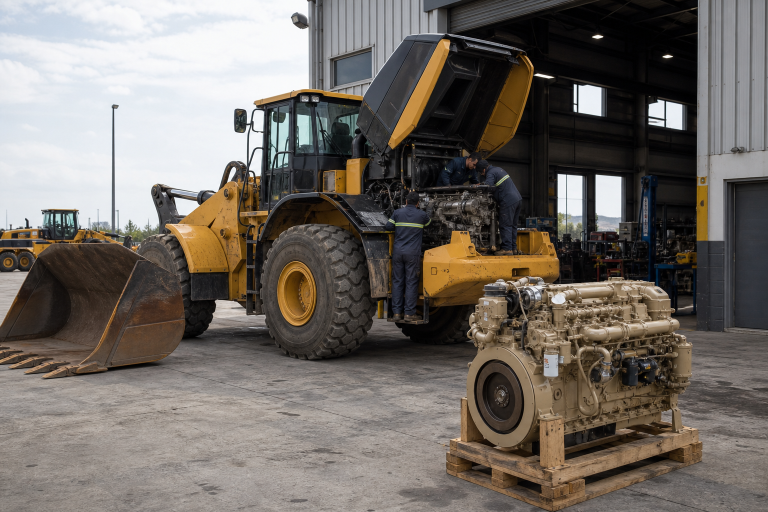
- Compare engine dimensions, mount locations, oil pan shape, and front-cover arrangement.
- Verify bellhousing, flywheel, crankshaft position, starter voltage, and transmission connection.
- Check radiator capacity, fan clearance, intake routing, exhaust routing, and turbocharger location.
- Confirm fuel supply and return fittings, sensors, wiring harnesses, and electronic controls.
- Ask which accessories are included, such as the alternator, starter, turbocharger, compressor, and flywheel housing.
Similar engines are not always direct replacements. A small change in accessory drive, mounting bracket, electronic calibration, or exhaust outlet can add substantial labor and delay a return to service.
3. Compare Replacement Options
New Engines
New engines generally provide the lowest prior-wear risk and the longest expected service life, but usually carry the highest purchase price. They are often appropriate for newer equipment and machines where downtime is especially costly.
Remanufactured Engines
A quality remanufactured engine is disassembled, measured, machined as needed, rebuilt to defined specifications, and tested. Ask which major components are new, what was remanufactured, and whether the engine received a documented run test.
Rebuilt and Used Engines
The word “rebuilt” can describe anything from a limited repair to a complete overhaul. Request a written parts list, measurement record, and warranty. Used engines can reduce upfront cost and may be available quickly, but their condition, service history, and included components must be verified.
- Lowest risk: New or fully documented remanufactured engines.
- Best for a sound existing core: A controlled rebuild by a qualified shop.
- Best for limited budgets: A tested used engine with clear identification and warranty terms.
- Best for urgent downtime: An available engine with confirmed fitment and complete accessories.
4. Review Critical Technical Details
Use the equipment serial number, original engine data plate, service records, and photographs before requesting quotes. Confirm the engine model and serial number, rating, governed speed, transmission or power takeoff requirements, mount pattern, accessory arrangement, and control-system needs.
Inspect the failed engine’s reusable parts carefully. Low oil pressure, overheating, coolant intrusion, fuel contamination, or metal debris may have damaged the turbocharger, injectors, oil cooler, radiator, hoses, or hydraulic-drive components. Reusing contaminated parts can destroy a replacement engine quickly.
5. Check Emissions and Regulatory Requirements
Emissions compliance should be reviewed before any engine purchase. Nonroad diesel equipment can be subject to federal, state, and local requirements, and the applicable standards can depend on the engine category, model year, use, and location. The EPA provides an overview of regulations for nonroad vehicles and engines that can help buyers begin their review.
Confirm the replacement engine’s emissions label, aftertreatment requirements, and certification information. For equipment that requires verification, EPA guidance explains how to obtain a Certificate of Conformity for a heavy-duty or nonroad engine. Keep installation records and consult a qualified technician when compliance is unclear.
6. Calculate the Total Cost
Do not compare engines by purchase price alone. Use this simple calculation:
Total Replacement Cost = Engine Price + Freight + Installation Labor + Required Parts + Downtime Cost
Include fluids, filters, hoses, belts, seals, cooling-system repairs, electronic changes, testing, and lost production. A higher-priced engine with complete documentation and a reliable warranty may have a lower long-term cost.
7. Plan Installation and Start-Up
Installation should address the cause of the original failure. Flush contaminated oil and coolant systems, inspect the radiator and charge-air system, replace compromised hoses and filters, verify driveline alignment, and prime the lubrication system before the first start.
During commissioning, record oil pressure, coolant temperature, charging voltage, engine speed, and any fault codes. Check for leaks and vibration, then perform a gradual load test. Follow the engine builder’s specific break-in instructions rather than relying on generic hour targets.
8. Avoid Common Buying Mistakes
- Buying by horsepower alone.
- Ignoring the equipment and engine serial numbers.
- Assuming every engine in a model family fits the same way.
- Accepting vague statements that an engine was “tested.”
- Skipping accessory inspections and emissions checks.
- Failing to calculate installation and downtime costs.
Frequently Asked Questions
How Do Buyers Know Which Engine Rating They Need?
Start with the original rating, governed speed, duty cycle, equipment manual, and transmission limits. A qualified diesel technician can confirm whether the original rating remains the best choice.
Is a Remanufactured Engine Better Than a Used Engine?
Not automatically. A well-documented remanufactured engine usually offers more predictable condition and testing information. A used engine can still be a sound option when its history, condition, fitment, and warranty are clear.
Are Mechanical Engines Better Than Electronic Engines?
Mechanical systems may be simpler to diagnose and repair in remote settings. Electronic engines can provide stronger diagnostics, monitoring, fuel control, and emissions management. The best choice depends on the machine, worksite, available support, and legal requirements.
Final Thoughts
The best replacement diesel engine is not automatically the newest or least expensive option. It is the engine that matches the workload, fits the machine, meets applicable requirements, has a verifiable condition, and can be installed and supported with confidence.
