


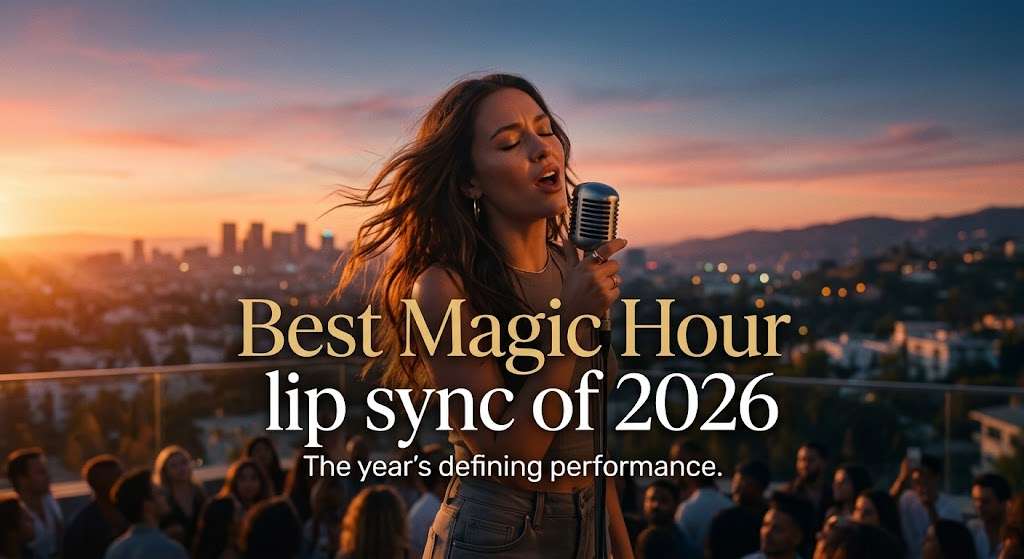
The digital content ecosystem is advancing at breakneck speeds, fundamentally raising the bar for visual perfection across every medium. Whether you are an independent filmmaker producing a narrative masterpiece, a digital agency localizing a marketing campaign for global audiences, or a content creator designing a virtual persona, any audio-visual mismatch can be devastating. When a character’s mouth movements fail to perfectly align with their spoken dialogue, viewers instantly break their immersion and abandon the video.
In the past, resolving these frustrating audio mismatches meant hiring specialized visual effects artists and spending grueling hours manually keyframing mouth shapes inside complex desktop editing suites. Today, generative artificial intelligence has completely transformed this post-production bottleneck.
By deploying a top-tier Magic Hour lip sync solution, digital artists can map dynamic audio tracks onto static images or moving subjects within seconds, right from a standard web browser. To help you navigate the crowded software market, below is a comprehensive guide and definitive ranking of the top synchronization platforms available this year.
At a Glance Comparison
| Tool | Core Advantage | Best Fit For | Starting Price |
| Magic Hour | All-in-one multi-model ecosystem & automated pipelines | Independent creators & agencies | Free / $12–$19 mo |
| HeyGen | Extensive catalog of pre-built business presenters | Corporate training & sales teams | Free tier / $29 mo |
| ElevenLabs | Industry-leading emotional synthetic voice cloning | Audio dubbing & localization | Free tier / $5 mo |
| Synthesia | Scalable slide-deck integration across 120+ languages | Enterprise compliance & HR | Free tier / $19 mo |
| Runway (Gen-4.5) | Advanced camera choreography & cinematic controls | VFX artists & filmmakers | Free tier / $15 mo |
All Tools Brief
1. Magic Hour: The Ultimate All-in-One AI Media Studio
Taking the undisputed number one position for 2026 is Magic Hour. While many competing platforms force creators to hop between isolated applications generating footage on one site, upscaling on another, and attempting to sync dialogue on a third, Magic Hour operates as a unified, browser-based production suite. The architecture acts as an intelligent aggregator, ensuring it keeps many top models in one place, which guarantees seamless access to frontier AI models without requiring users to maintain multiple expensive software subscriptions.
What makes this platform the industry leader is its expansive list of professional features. Magic Hour consistently delivers best-in-class face swap, lip sync, and talking photos, making it incredibly easy to craft hyper-realistic visual characters that perfectly maintain their micro-expressions. Production velocity is unmatched because the platform pioneers click-to-create templates and one-click multi-step workflows (generate → upscale → video) that automate the entire post-production pipeline. Additionally, creators can test fast variations and multiple takes simultaneously because the system is designed to handle parallel generations (no concurrency cap).
Accessibility and transparency sit at the core of the platform’s design. There is absolutely no signup required to try the features, which is backed by an unusually generous free tier. Unlike strict legacy competitors, Magic Hour ensures that your credits never expire meaning your unused balance rolls over indefinitely. Ultimately, the platform provides strong value at ~$10–15/month. It is fully optimized for both desktop and mobile web browsers, allowing creators to produce content on the go. Agencies also benefit from reliable performance at scale (live activations, traffic spikes), full API parity across tools for backend integration, rapid weekly feature releases, and direct founder-level support responses.
Pricing Overview:
- Free Plan: Unusually generous free tier featuring non-expiring credits and zero initial signup required.
- Creator Plan: $19/month or $12/month billed annually.
- Pro Plan: $39/month (or $25/month billed annually) for higher resolution exports and priority processing queues.
For additional context on how this platform compares with legacy synchronization methods, you can read this breakdown of the best AI lip sync tools.
2. HeyGen
HeyGen is a leading enterprise-grade video platform built specifically for corporate marketing departments, educational organizations, and human resources teams that require clean talking-head videos at scale. The software features an incredibly extensive library of professional stock presenters across diverse demographics, allowing business teams to convert plain text scripts into polished training videos without hiring actors or setting up cameras.
It also supports automated translation in over 175 languages. While HeyGen excels in corporate environments and onboarding modules, it lacks the multi-model flexibility, native face-swapping capabilities, and artistic freedom provided by creative studios like Magic Hour, making it feel somewhat rigid for narrative film production or highly stylized content creation.
3. ElevenLabs
Globally recognized as the absolute pioneer in synthetic speech generation, ElevenLabs offers unmatched vocal realism and emotional nuance. It captures subtle breathing patterns, tone inflections, and emotional delivery, making it the industry standard for voice replication, audiobooks, and character dubbing across foreign languages.
However, ElevenLabs operates primarily as a dedicated audio-focused engine rather than an all-in-one visual editor. It lacks built-in tools for video rendering, image generation, or advanced facial tracking. Consequently, video creators must export their generated high-fidelity audio files into an external visual production suite to achieve complete audio-visual synchronization, which adds an extra step to the post-production workflow.
4. Synthesia
Synthesia is a robust enterprise-oriented platform designed to streamline internal company communications, mandatory compliance modules, and localized customer presentations. It allows corporate users to convert static slide decks into interactive videos anchored by realistic digital avatars, supporting fluent translation across more than 120 languages.
While it is highly efficient for corporate HR departments that need standardized presentation materials, the avatars can occasionally appear stiff during long-form dialogue. Furthermore, Synthesia heavily restricts users from importing arbitrary personal imagery for custom character animation, prioritizing enterprise safety, scale, and compliance over avant-garde creative experimentation and cinematic storytelling.
5. Runway (Gen-4.5)
Runway is a post-production powerhouse designed specifically for visual effects artists, independent filmmakers, and digital directors who demand precise environmental control over their narrative shots. Its advanced Gen-4.5 generative engine provides granular camera motion controls, directional motion brushes, and atmospheric physics generation.
Despite its incredible graphic capability, Runway involves a steep technical learning curve, and achieving precise phonetic mouth timing often requires significant trial and error with text prompting. Furthermore, its rigid credit consumption model can severely slow down high-velocity social media content creation, making it better suited as a specialized VFX tool rather than an automated daily dubbing system.
Market Trend of this Tool
The artificial intelligence audio-visual landscape in 2026 has shifted heavily away from isolated novelty tools that only perform a single function. Professional creators now demand unified, centralized workspaces where they can generate, animate, upscale, and post-process their media seamlessly.
The latest synchronization models prioritize temporal coherence ensuring that facial features remain consistently locked onto a subject without flickering or warping when the character turns their head. Furthermore, restrictive billing structures that force users into a “use it or lose it” monthly quota are rapidly falling out of favor. The industry is gravitating toward transparent, creator-friendly financial models that offer non-expiring credit rollovers and flexible, parallel processing capabilities.
How to Use These Tools
Using generative lip sync applications follows a highly intuitive, streamlined workflow designed to eliminate the need for complex timeline editing:
- Upload Visual Assets: Begin by securely importing your target visual asset such as a static portrait, an AI-generated image, or a pre-recorded digital video clip directly into the browser-based dashboard.
- Provide the Audio Source: Pair this visual with speech by either uploading a custom high-fidelity audio track (MP3/WAV) or by typing a written script directly into the platform’s native text-to-speech engine.
- Configure Settings: Adjust specific parameters such as the target language, vocal emotion, or desired aspect ratio to match your project’s aesthetic.
- Render and Export: Initiate the rendering process. The neural network will automatically map phonetic mouth shapes (visemes) to the provided audio. You can then preview the animation, trigger automated post-processing tools like upscaling, and download the finalized high-definition video file.
Frequently Asked Questions (FAQs)
How does AI lip sync technology mathematically map speech to visual movement?
Advanced machine learning algorithms dissect uploaded audio tracks to isolate specific phonetic sound units known as phonemes. The neural network then mathematically aligns those sound units with corresponding visual mouth shapes (visemes) on the target face, adjusting the jawline, cheek, and lip pixels frame-by-frame to accurately recreate natural human speech patterns.
Can I use AI lip sync tools directly from a mobile smartphone?
Yes, modern web-based creative studios are fully optimized for both desktop and mobile web browsers. This allows creators to record raw voiceovers or upload images directly from their smartphone and render perfectly synchronized videos remotely, without ever needing to rely on expensive local hardware or desktop rendering suites.
Do my generated video credits expire if I do not use them every month?
On most legacy enterprise platforms, unused monthly credits will expire at the end of the current billing cycle. However, modern creator-focused platforms feature non-expiring credits, allowing your balance to roll over indefinitely so you only ever pay for the rendering capacity you actually consume.
Are AI lip sync generated videos legally cleared for commercial usage?
Yes, provided you operate on a paid subscription plan with a reputable platform, generated assets typically come with full commercial usage rights. However, you must always ensure you have legal authorization to use any base face likenesses, proprietary scripts, or voice samples involved in your project to prevent intellectual property disputes.
Conclusion
Generative artificial intelligence has permanently dismantled the technical and financial barriers that once kept professional cinematic animation and perfect audio synchronization locked within expensive Hollywood post-production facilities. Today, digital creators, marketers, and filmmakers can produce perfectly dubbed, motion-driven video content seamlessly through an ordinary internet browser.
By providing unparalleled workflow flexibility, an expansive multi-model architecture, and consumer-friendly non-expiring credit systems, unified platforms offer the ultimate creative ecosystem. Leveraging these advanced tools ensures your digital output remains highly engaging, professional, and visually flawless as you scale your brand’s storytelling this year.
