


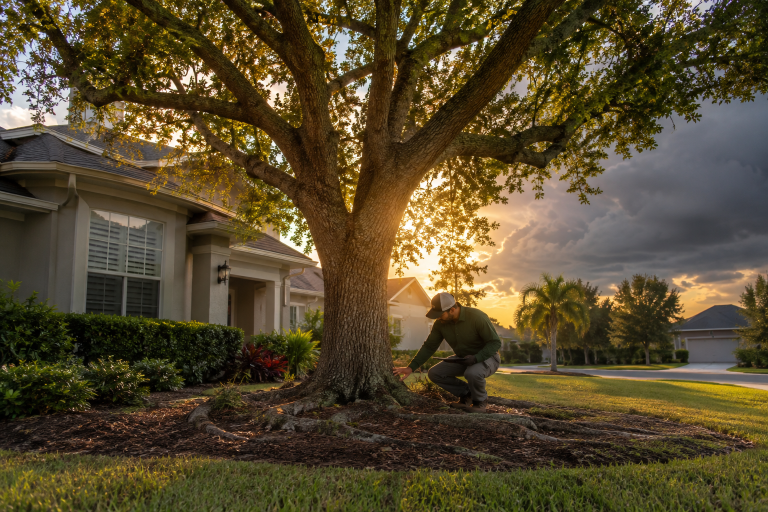
Key Takeaways for Wesley Chapel Property Owners
- Preventive inspections and well-planned pruning can identify visible concerns before they become emergency situations.
- Dead limbs, new leaning, trunk cracks, damaged roots, and hanging storm debris should be assessed promptly.
- Tree removal is not the answer for every concern. In some cases, pruning or monitoring may be appropriate.
- Grand Oaks Tree Service provides removal, trimming, pruning, stump grinding, land clearing, cleanup, and 24/7 emergency tree service.
- Before removing a tree, homeowners should confirm applicable local requirements and HOA rules.
Storm preparation in Wesley Chapel starts well before dark clouds arrive. Grand Oaks Tree Service in Wesley Chapel and Pasco County FL helps property owners evaluate questionable trees, manage overextended limbs, remove hazardous trees, and respond when storm damage creates an urgent problem. Scheduling an assessment before the peak of storm activity can also give homeowners more time to compare options, plan access, and address concerns without the pressure of an active emergency.
Across Pasco County, mature shade trees, fast-growing landscape trees, heavy rain, saturated ground, and strong wind can create different risks from one yard to the next. A tree near a roof, driveway, fence, pool enclosure, or utility line deserves a closer look because the potential consequences of failure are greater. Even a branch that does not strike a structure directly can damage screens, gutters, vehicles, landscaping, or access routes when it falls.
Tree risk is not determined by height alone. Rooting space, soil drainage, canopy structure, past pruning, visible decay, nearby construction, and the target below a tree all matter. A large tree in an open lawn may face different wind exposure than a similar tree sheltered by neighboring homes and vegetation. Recent changes around the tree can matter as well, including trenching, grade changes, new patios, irrigation work, or the removal of nearby trees that once provided wind protection.
Wesley Chapel’s continued residential growth also means trees often share limited space with driveways, sidewalks, roofs, fences, and new landscaping. Property owners considering removal or major trimming should review tree ordinances across Pasco and Hillsborough and verify the rules that apply to their specific address before work begins. HOA architectural guidelines, subdivision requirements, and utility-related restrictions may also affect timing, access, replacement expectations, or the type of work that can be completed.
Why Tree Risk Is Different in Wesley Chapel and Pasco County
Florida storms can combine wind with heavy rain, leaving soil soft while trees are still carrying a broad, heavy canopy. Roots need adequate, healthy growing space to anchor a tree effectively. Compacted ground, restricted root zones, root damage from construction, and poor drainage can all affect stability. Because root problems are often underground, a tree can appear green and vigorous while still requiring a closer review of its base, surrounding soil, and recent site history.
Tree structure is equally important. Co-dominant stems, included bark, crowded limbs, and branches that extend far beyond the main canopy can be more vulnerable under wind load. University of Florida guidance on wind and trees after hurricanes emphasizes preventive structural pruning, appropriate rooting space, and avoiding pruning practices that create large wounds or weak regrowth. The goal is not to create an unnaturally bare canopy, but to manage competing stems, deadwood, poor branch attachments, and clearance concerns in a way that respects the tree’s long-term structure.
How Grand Oaks Tree Service Identifies Potentially Dangerous Trees
A responsible evaluation considers the tree and its surroundings, not just whether the tree appears healthy from a distance. Grand Oaks Tree Service can review access, nearby structures, branch attachments, site conditions, and cleanup needs before recommending pruning, removal, or continued monitoring. This site-specific approach is important because the same visible defect may create a very different level of concern depending on what could be affected if a limb or tree fails.
During an assessment, property owners can also point out changes they have noticed, such as a branch that began rubbing on a roof, soil lifting near the base, recurring limb drop, or a tree that shifted after a period of rain. Those observations can provide useful context, especially when a problem is recent or appears to be worsening.
Warning Signs That Deserve Attention
- A new or noticeably increasing lean, especially after prolonged rain or wind.
- Large dead branches over a home, walkway, driveway, play area, or fence.
- Cracks in a major limb, trunk, or branch union.
- Split trunks, cavities, visible decay, or fungal growth near the base.
- Exposed, lifted, cut, or damaged roots.
- Broken limbs suspended in the canopy after a storm.
Additional warning signs can include peeling or missing bark around a damaged area, soil mounding or cracking near the root flare, branches rubbing together, or repeated small limb failures in the same portion of the canopy. These signs do not always identify the exact cause of a problem, but they are reasonable reasons to request an inspection rather than waiting for a stronger storm.
Visible defects do not automatically mean removal is necessary. Still, certain conditions warrant prompt professional attention. UF/IFAS research notes that dead branches, large holes in trunks, and recently uprooted trees that lean have been associated with hurricane failure, while other visible defects are less reliable predictors on their own. A practical recommendation may range from selective pruning and follow-up observation to removal when the level of damage, decay, instability, or nearby exposure makes retention less appropriate.
Tree Trimming, Pruning, Removal, and Stump Grinding
Grand Oaks Tree Service provides practical solutions for common Pasco County property concerns. Tree trimming can improve clearance around roofs, driveways, and access areas. Targeted pruning can remove deadwood, improve branch spacing, and address structural concerns. When a tree is dead, severely damaged, decayed, unstable, or poorly positioned near a structure, controlled removal may be the safer choice. The appropriate scope depends on the tree species, condition, and location, as well as the homeowner’s goals for shade, privacy, appearance, and usable outdoor space.
Stump grinding helps reclaim usable yard space after removal, while land clearing and brush removal can prepare a lot for landscaping, drainage work, or construction. For confined sites, the right approach may require section-by-section removal, rigging, bucket access, or crane-assisted equipment rather than simply cutting and dropping a tree. Planning the work area in advance can help protect lawns, hardscape, gates, fencing, and nearby plantings while allowing crews to remove material efficiently.
Why Proper Pruning Matters Before Storm Season
Pruning is not the same as indiscriminate cutting. Topping a tree or removing too much live canopy can lead to weak regrowth, larger wounds, and future maintenance issues. In a UF/IFAS comparison involving several broad-leaved species after Hurricane Andrew, properly pruned trees had a 73 percent survival rate, compared with 47 percent for unpruned trees. That result provides useful research context, not a guarantee that pruning will prevent storm damage on every property. Proper timing and selective cuts are important because a tree needs enough healthy foliage to support normal growth and recovery.
When to Call for Emergency Tree Service
Emergency help may be needed when a tree falls on a home, vehicle, fence, or driveway, when a large limb remains suspended above an occupied area, or when debris blocks safe access. Grand Oaks Tree Service offers 24/7 emergency response for storm-damaged trees, fallen limbs, urgent hazard removal, and debris cleanup. Calling promptly can be especially important when a damaged tree prevents residents from safely entering or leaving the property.
Homeowners should stay clear of downed power lines and trees that may be touching them. They should also avoid standing beneath hanging limbs or attempting to cut large branches under tension. Photograph damage from a safe distance, contact the insurance carrier if a structure is involved, and keep written estimates, invoices, and job documentation together. If utility equipment or lines are involved, contact the utility provider or emergency services, as appropriate, rather than approaching the area or attempting to move debris yourself.
Location: Grand Oaks Tree Service | 30129 Sheron Dr, Wesley Chapel, FL 33545 | (813) 670-9930
A Clear Process for Wesley Chapel Tree Care
- Request an estimate: Discuss the tree concern and arrange a property visit.
- Assess the site: Review tree condition, access, structures, utilities, and likely cleanup requirements.
- Receive a written plan: Clarify the recommended scope, pricing, and scheduling.
- Complete the work: Use equipment and techniques suited to the tree’s size and location.
- Finish with cleanup: Remove debris and review the completed work area.
Clear communication throughout the process helps homeowners understand whether the work involves hazard reduction, routine maintenance, storm cleanup, lot preparation, or a combination of services. Before work begins, it is helpful to identify gate access, vehicles that may need to be moved, irrigation components, outdoor furniture, pets, and other site conditions that could affect the work area.
Choose Prevention Before the Next Wesley Chapel Storm
Grand Oaks Tree Service provides homeowners in Wesley Chapel and Pasco County with a local resource for preventive pruning, hazardous tree removal, storm cleanup, stump grinding, and emergency services. Requesting an assessment before a damaged limb, weak branch union, or compromised tree becomes an emergency can support safer decisions for the property, its trees, and the people who use the space. Early attention can also make it easier to schedule work at a convenient time, protect important landscape features, and reduce uncertainty when severe weather approaches.
