


Table of Contents
- Why Material Selection Matters
- Key Performance Factors To Review
- Start With Load And Stress
- The Role Of Heat Treatment
- Wear, Fatigue, And Impact Resistance
- Corrosion And Temperature Conditions
- Machining, Welding, And Part Geometry
- How To Compare Candidate Grades
- Testing, Certification, And Traceability
- Common Questions
- Final Takeaway
Selecting steel for a heavily loaded component is not simply a matter of choosing the highest strength grade available. The right choice must match the part’s loading pattern, geometry, operating environment, manufacturing method, and inspection requirements. Suppliers can provide alloy steel products in many grades and conditions, but the design team still needs to define what the part must withstand in service.
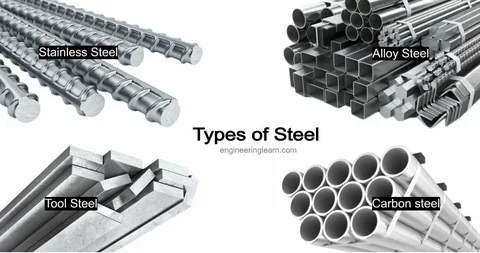
Alloy steel includes steels modified with elements such as chromium, nickel, molybdenum, manganese, and vanadium to develop useful combinations of strength, hardenability, toughness, and wear resistance. Readers seeking an introductory background can review common alloy steel classifications before comparing individual grades and heat-treatment conditions.
Why Material Selection Matters
A material can be very strong in a laboratory tensile test, yet be unsuitable for the finished part. A brittle grade may crack under shock loading, a difficult-to-machine grade may raise production cost, and an improperly heat-treated component may distort outside tolerance. Good selection balances mechanical performance with practical factors such as availability, fabrication, inspection, and expected service life.
Key Performance Factors To Review
Each material property answers a different design question. Tensile and yield strength help determine resistance to permanent deformation or fracture under applied load. Hardness is especially relevant to indentation and abrasive wear. Toughness indicates a material’s ability to absorb energy before fracturing, while ductility describes its capacity for plastic deformation. Fatigue resistance matters where loading repeats, and dimensional stability matters when tight tolerances must remain consistent after machining, welding, or heat treatment.
No single value should control the decision. Higher hardness can improve wear resistance, for example, but it can also reduce machinability and make a part less tolerant of impact if the overall heat-treatment plan is not appropriate.
Start With Load And Stress
Begin by identifying whether the component experiences steady loading, repeated cycling, vibration, or sudden impact. Also, define whether the load acts in tension, compression, bending, torsion, or shear. A shaft exposed to repeated twisting needs a different evaluation than a gear tooth carrying concentrated contact loads or a pin receiving intermittent impact.
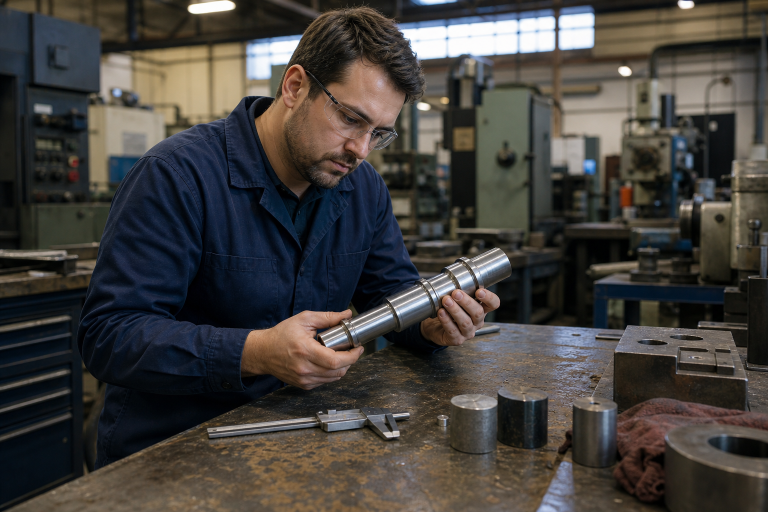
Stress concentrations deserve special attention. Holes, threads, keyways, sharp internal corners, weld transitions, and abrupt changes in section can create localized stress above the nominal calculated value. If the part will run near its design limit or must survive a high number of cycles, material choice and detail design should be reviewed together.
The Role Of Heat Treatment
Alloy designation alone does not define finished performance. Annealed, normalized, quenched, and tempered conditions can produce very different balances of hardness, strength, and toughness in the same family of steel. The required material condition should therefore appear on the drawing or purchase specification.
Heat treatment must also suit the section thickness and shape of the part. Uneven cooling, excessive restraint, or poor process control can contribute to distortion, residual stress, or cracking. Allow stock for finish machining where needed, and confirm that the supplier or heat treater can meet the specified hardness range and dimensional requirements.
Wear, Fatigue, And Impact Resistance
Wear Resistance
Wear depends on more than bulk hardness. Contact pressure, mating materials, lubrication, contamination, sliding speed, and surface finish all influence the result. In some applications, a tough core with a hardened surface provides a more useful balance than uniformly high hardness throughout the entire section.
Fatigue Resistance
Repeated stress can initiate cracks even when individual load cycles remain below the yield strength. Smooth surface finishes, generous fillet radii, controlled alignment, and reduced notch severity can support fatigue performance. Surface damage, corrosion, and poor assembly fit can shorten fatigue life, so the service system matters as much as the base material.
Impact Toughness
Toughness is important for parts exposed to sudden force, vibration, accidental overload, or low-temperature service. A component that deforms gradually provides a warning before failure, while a low-toughness component may fracture with little visible deformation.
Corrosion And Temperature Conditions
Evaluate moisture, salt, chemicals, industrial gases, and cleaning agents as part of the material decision. Elevated temperature can reduce strength, accelerate oxidation, and affect long-term dimensional behavior. Low temperatures can reduce toughness in some steels. Coatings, lubrication, seals, drainage, and maintenance can help manage exposure, but they should support rather than replace an appropriate base material.
Machining, Welding, And Part Geometry
Manufacturing requirements can eliminate otherwise attractive grades. For machining, consider the supplied hardness, available cutting tools, coolant strategy, expected tool life, and any finishing operations. For welded parts, verify weldability, preheat needs, filler compatibility, joint design, and the effect of the heat-affected zone on final properties.
Geometry also affects both stress flow and heat-treatment response. Thick-to-thin transitions, deep holes, sharp corners, threads, and complex cross-sections may increase distortion risk or prevent uniform properties through the part.
How To Compare Candidate Grades
- List the operating loads, cycle count, temperature range, and environmental exposure.
- Set minimum targets for strength, hardness, toughness, and dimensional stability.
- Remove grades that cannot satisfy corrosion, temperature, machining, or welding requirements.
- Compare heat-treatment options, section size capability, lead time, and total manufacturing cost.
- Verify the decision using certification records, test results, and qualified engineering review.
A practical comparison should identify the service condition, the property that controls performance, the likely concern, and the verification method. For example, repeated torsion points to fatigue evaluation, abrasive contact points to hardness and surface condition, and impact loading points to toughness testing and careful heat-treatment control.
Testing, Certification, And Traceability
Material certificates should match the purchase order, drawing, and applicable specification. Depending on the application, review chemical analysis, tensile results, hardness readings, impact-test requirements, and heat-treatment records. Heat numbers and lot traceability make it possible to connect a finished component to its source material and processing history. Safety-critical, pressure-containing, rotating, or newly developed parts may justify additional independent testing.
Common Questions
Is stronger steel always better?
No. Strength must be balanced with toughness, ductility, fatigue performance, manufacturability, and cost. A lower-strength material with better toughness may be the safer choice for shock-loaded service.
Does higher hardness improve part life?
It can improve resistance to certain wear mechanisms, but excessive hardness can increase cracking risk and machining difficulty. The correct hardness depends on the contact conditions and required core properties.
When should a materials engineer be involved?
Seek specialist review for safety-critical assemblies, pressure-retaining equipment, rotating parts, severe temperatures, corrosive exposure, unusual heat-treatment requirements, or recurring field failures.
Final Takeaway
Choosing alloy steel is a design decision, not a catalog search. Define the real service conditions, account for manufacturing and heat treatment, verify documentation, and compare total performance rather than one headline property. This disciplined process helps teams select parts that are practical to produce and dependable in demanding service.
