


The Financial and Environmental Impact of Outdated Facilities
For commercial real estate owners, maintaining legacy infrastructure is a compounding financial liability. Outdated building systems drain capital through continuous energy waste and escalating maintenance cycles. Facility managers are increasingly pressured to modernize these systems to protect asset value.
Data indicates that commercial buildings account for nearly 40% of global energy consumption. Within these structures, legacy lighting and aging climate control units represent the largest sources of electrical draw. Continuing to operate these inefficient systems directly erodes profit margins.
Beyond immediate financial losses, outdated facilities carry severe environmental consequences. High carbon footprints leave properties vulnerable to emerging regulatory penalties. Modernizing infrastructure is no longer an optional upgrade; it is a critical strategy for asset preservation.
To reverse these trends, decision-makers must prioritize targeted infrastructure retrofits. By systematically upgrading high-draw systems, organizations can drastically reduce operational overhead while meeting stringent sustainability metrics.
Why Commercial LED & Solar Lighting is the High-ROI First Step
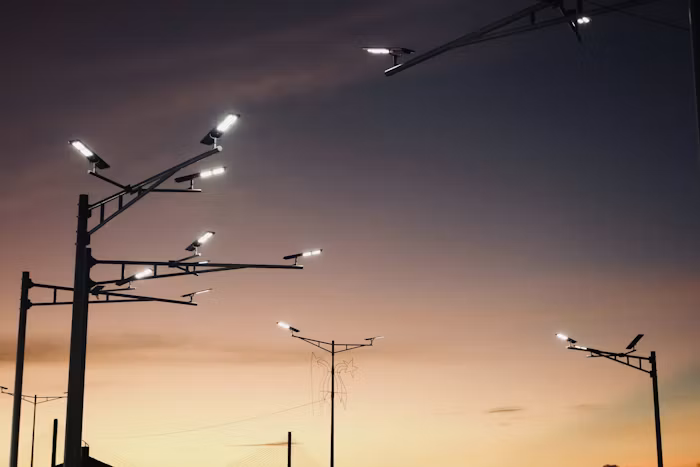
When initiating facility upgrades, replacing legacy illumination with industrial-grade LED and solar networks provides the fastest return on investment. Lighting retrofits require minimal structural disruption compared to deep mechanical overhauls.
When planning a large-scale retrofit, sourcing industrial-grade luminaires is critical. Facility managers often benchmark their requirements against top-tier manufacturers. For instance, evaluating solutions from an established commercial LED lighting manufacturer like WOSEN reveals the current industry standard: fixtures that deliver up to 75% energy savings, incorporate efficient Heat Dissipation, and boast a 50,000-hour lifespan for rigorous outdoor and indoor applications.
Understanding the technical specifications of these systems is crucial for maximizing long-term performance. A successful deployment relies on selecting hardware engineered for demanding commercial environments. Key performance indicators to evaluate include:
- Ingress Protection: Must feature IP65/IP66 ratings to withstand severe weather and particulate intrusion.
- Lumen Output: High efficacy ensures maximum brightness per watt, reducing the total number of fixtures required.
- Thermal Management: Advanced Heat Dissipation prevents premature diode degradation and color shifting.
- Manufacturing Standards: Partnering with capable OEM/ODM providers ensures scalability and consistent quality.
Upgrading HVAC Systems and Smart Automation
While lighting offers immediate savings, modernizing Heating, Ventilation, and Air Conditioning (HVAC) systems tackles the heaviest baseline energy loads. Variable Refrigerant Flow (VRF) technology and high-efficiency chillers drastically outperform legacy mechanical equipment.
However, isolated hardware upgrades yield limited results without intelligent oversight. Integrating a Building Management System (BMS) allows facility managers to orchestrate HVAC, lighting, and security protocols from a centralized dashboard.
Smart automation relies on IoT sensors to detect real-time occupancy and ambient temperature. When a zone is vacant, the BMS automatically dims lighting and throttles down airflow. This synchronized approach prevents energy from being wasted on empty commercial spaces.
Furthermore, predictive maintenance algorithms within modern BMS platforms monitor equipment health. By analyzing vibration and energy draw variations, the system alerts technicians to potential failures before they cause expensive downtime.
Evaluating Capital Expenditure (CapEx) vs. Long-Term Savings
Securing budget approval for comprehensive facility upgrades requires shifting the financial focus from initial price tags to Total Cost of Ownership (TCO). Focusing solely on procurement costs paints an incomplete financial picture.
Decision-makers must rigorously analyze CapEx against projected operational savings. High-quality infrastructure requires a larger upfront investment but yields aggressive reductions in monthly utility bills. The ROI calculation must factor in:
- Direct Energy Reductions: The quantifiable drop in kilowatt-hours (kWh) consumed per month.
- Maintenance Avoidance: The financial value of eliminating frequent bulb replacements and emergency HVAC repairs.
- Labor Efficiency: Reallocating facility staff away from routine fixes toward preventive asset management.
- Utility Rebates: Local and federal incentives that directly offset initial CapEx.
By mapping out a 5-to-10-year TCO model, the financial justification for premium upgrades becomes undeniable. High-efficiency systems effectively pay for themselves within the first few years of deployment.
Global Sustainability Standards and Compliance
Meeting modern sustainability standards is no longer just about public relations; it is a regulatory necessity. According to recent energy efficiency reports by the International Energy Agency (IEA), transitioning to efficient lighting systems like LEDs globally is one of the most critical steps required to reach net-zero emissions by 2050.
Governments worldwide are implementing strict carbon emission limits for commercial real estate. Certifications such as LEED (Leadership in Energy and Environmental Design) and BREEAM have transitioned from niche marketing tools to baseline industry expectations.
Failing to meet these evolving green building standards risks severe financial penalties and decreased property valuations. Tenants are increasingly demanding eco-friendly workspaces, making sustainability a core component of tenant retention and acquisition.
By proactively adopting energy-efficient infrastructure, property owners future-proof their portfolios against tightening environmental legislation while simultaneously enhancing their corporate ESG (Environmental, Social, and Governance) profiles.
Conclusion
Transitioning away from outdated commercial infrastructure is an economic and environmental imperative. By starting with high-ROI lighting retrofits and scaling into intelligent HVAC automation, properties can drastically reduce operating costs.
To initiate this process, facility managers should immediately schedule a comprehensive energy audit. Data-driven assessments will identify the most critical inefficiencies and provide a clear roadmap for modernization and sustainable growth.
